Bangladesh Jamaat-e-Islami
Election Manifesto 2026
What's Actually in It? A Proper Look.
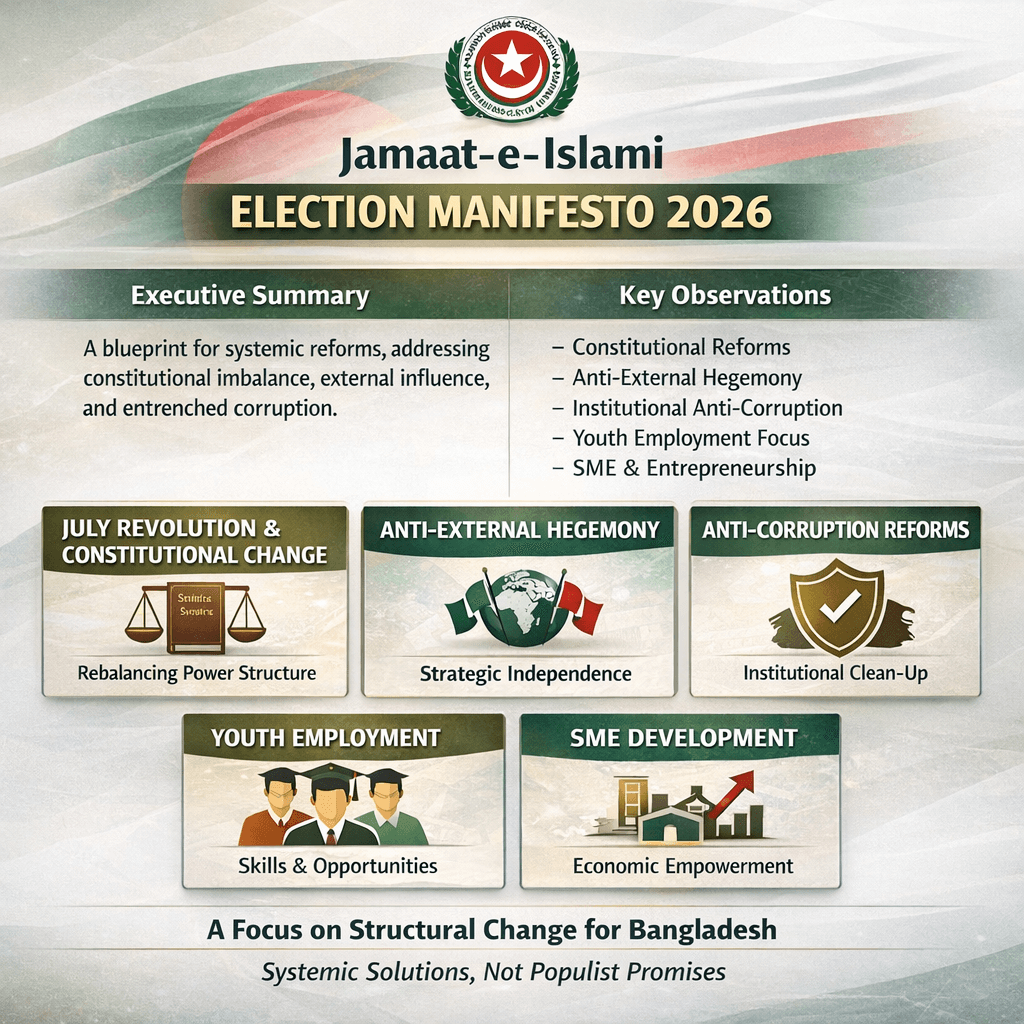
Right, so here's the thing about Jamaat-e-Islami's 2026 manifesto: it's not your typical "we'll give you free stuff" election promise list. Instead, they're basically saying Bangladesh's problems run much deeper than that.
It's like trying to fix a leaking roof when the whole foundation is cracked. Their main argument? The country needs a complete overhaul. We're talking about fixing the system itself, not just slapping on some plasters and hoping for the best.
The focus is on rebuilding how the government actually works, creating proper jobs (not just handing them out), and making Bangladesh less dependent on everyone else. It's ambitious, sure, but whether it's realistic is another question entirely.
What Makes This Different?
Most manifestos promise benefits — cheaper this, free that. This one's more like "we need to rebuild the entire house because the wiring's dodgy and the plumbing's knackered."
System vs. Goodies
It's about fixing systems, not handing out goodies.
Most manifestos promise benefits. This one is different. They focus on rebuilding the structure itself. It's not about temporary relief; it's about ensuring the machinery of government works.
Rewriting the Rulebook
They want to rewrite the rulebook. Literally.
Constitutional reform is front and centre — changing how power works in Bangladesh from the ground up.
The Catch?
It's quite vague on the money side.
How much will all this cost? How will they pay for it? That bit's missing. Also, they don't mince words on foreign policy: stop being pushed around by bigger neighbours.
The July Revolution & The Constitution
Remember the July Revolution? Jamaat sees it as Bangladesh saying "enough is enough" to power being concentrated in too few hands.
What they're proposing:
- Limit PM Power: Stop the Prime Minister having so much power that nobody can challenge them. Right now, if you're PM, you basically run everything — and that's the problem.
- Empower Parliament: Make Parliament actually matter again. Currently, it's a bit like having a student council that the headteacher ignores completely.
- Democratic Safeguards: Bring back the safeguards that got quietly removed. Think of it like someone slowly removing all the fire exits from a building — you might not notice until you need them.
- Judicial Independence: Make sure judges can actually judge without politicians breathing down their necks. Proper independence, not just on paper.
Why it matters:
Their argument is dead simple: if power is too concentrated, corruption will always come back, no matter how many anti-corruption drives you run. It's like trying to stop mould in a damp house without fixing the leak — pointless.
Foreign Policy: Standing on Your Own Two Feet
This section's quite bold. Jamaat's basically saying Bangladesh has been too willing to do what bigger countries want instead of thinking about what's actually good for Bangladesh.
The main points:
- Foreign relations should be based on what benefits Bangladesh, full stop. Not what makes India happy, not what keeps China sweet — what actually helps ordinary Bangladeshis.
- No more letting bigger neighbours boss Bangladesh around on political, economic, or security issues.
- Still be friendly with neighbours (obviously), but as equals, not as the junior partner who does what they're told.
- Stop letting foreign powers meddle in Bangladesh's internal politics.
- Build stronger ties with Muslim-majority countries and emerging economies — basically, diversify who Bangladesh relies on.
What they're really saying:
Between the lines, this is about India. They're not explicitly naming names, but the "regional hegemony" language is pretty clear. They reckon Bangladesh has been too dependent and needs to assert itself more.
Actually Dealing with Corruption (Not Just Talking About It)
Everyone promises to fight corruption. Everyone. But Jamaat's approach is different — they reckon corruption isn't just about bad people doing bad things. It's about how the entire system is set up.
Their plan:
- Clean out institutions from top to bottom — not just catching corrupt officials, but fixing the systems that let corruption thrive.
- Hire people based on merit, not political connections. Radical concept, right? But currently, getting a government job or promotion often depends more on who you know than what you know.
- Make everything transparent and accountable — actually enforce it, not just write it in a document nobody reads.
- Create independent watchdog bodies with real teeth, not ones that can be shut down the moment they investigate someone powerful.
- Stop politicians controlling the police and regulatory agencies. When the people investigating corruption report to politicians, guess how effective they are?
The logic:
Corruption sticks around not because there aren't laws against it (there are loads), but because the institutions that should stop it are captured by the very people benefiting from it. It's like asking the fox to guard the henhouse.
Youth Employment & Small Businesses
Bangladesh has millions of young people entering the job market. This should be brilliant news, but if they can't find proper work, it becomes a massive problem.
4. Youth Employment: Skills, Not Shortcuts
Creating a million government jobs sounds great in an election campaign, but it's not sustainable. The government can't just keep hiring people forever.
- Education and training that actually matches what employers need. Currently, loads of graduates can't find jobs in their field because what they studied isn't what companies need.
- Massively expand vocational and technical training. Not everyone needs a university degree — skilled electricians, plumbers, IT technicians, and mechanics are in huge demand.
- Link education with actual business creation and innovation, not just credential-collecting.
It's the difference between giving someone a fish (a government job) and teaching them to fish (skills and entrepreneurship).
5. Small Businesses: The Real Engine
Big companies get all the attention, but small and medium-sized businesses (SMEs) are where most people actually work. Jamaat reckons these should be the absolute priority.
- Make it easier to start and run a small business — less red tape, less corruption, fewer bribes needed just to exist.
- Provide proper support, finance, and infrastructure for SMEs.
- Help local manufacturers and service providers compete, rather than everything being imported or dominated by a few massive companies.
Why SMEs matter:
They create jobs — loads of them. They reduce inequality. And crucially, they're harder for political elites to monopolise and control. Think of it this way: an economy dominated by a few huge companies connected to politicians is much easier to corrupt than one with thousands of small, independent businesses.
How Does It All Fit Together?
| What They're Focused On | Their Approach | How Government Works |
|---|---|---|
| Government Structure | Complete structural reform | Fix the system, not just catch bad guys |
| The Economy | Build productive businesses, not dependencies | Support SMEs (The Real Engine) |
| Young People | Skills and jobs, not just degrees | Skills, Not Shortcuts |
| Foreign Relations | Bangladesh first, always | Standing on Your Own Two Feet |
The Bottom Line
This manifesto is essentially a blueprint for rebuilding, not a promise of immediate benefits. That's either impressive or worrying, depending on your perspective.
It diagnoses Bangladesh's problems as deep, systemic failures rather than surface-level issues. That's probably quite accurate.
Implementation details are sketchy. How much will this cost? In what order will they do things? How long will it take? These crucial questions don't have clear answers yet.
The real test: Anyone can write an ambitious manifesto. The question is whether they can actually deliver it. That depends on detailed plans, fiscal transparency, and the political will to follow through when things get difficult.
Think of this as a serious proposal for fundamental change, not a list of quick fixes. Whether you buy into it depends on whether you think Bangladesh's problems need radical solutions — and whether you trust Jamaat to deliver them.