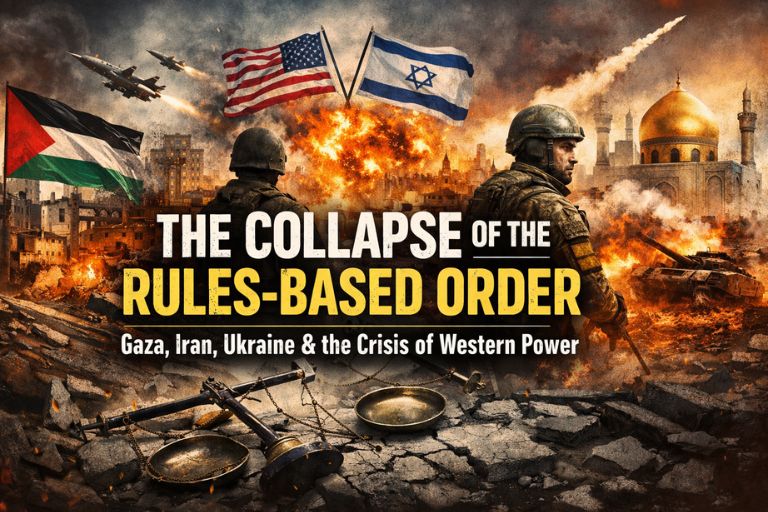
The Visible Breakdown
Part I — The Visible Breakdown
Most people still talk as if these are separate fires.
Ukraine is one fire.
Gaza is another.
Iran is another.
Syria was another.
Libya was another.
Iraq was another.
Afghanistan was another.
That is the first mistake.
These are not separate storms.
They are not random tragedies.
They are not isolated failures of diplomacy that just happened to land close together in time.
They are part of one larger breakdown.
Not every war is the same.
Not every actor is the same.
Not every lie is the same.
Not every crime has the same shape.
But the direction is the same.
The same habits keep returning.
The same moral tricks.
The same legal double standards.
The same selective outrage.
The same dead language about peace, restraint, law, and values.
The same belief that force can solve what wisdom refused to solve.
The same elite confidence that one more war can still be controlled.
That is what links these crises.
What we are watching is not just more violence.
We are watching the collapse of restraint.
And restraint is one of those things that people do not value enough until it is gone.
When restraint exists, even hypocrites still feel the need to hide.
Even empires feel the need to justify themselves.
Even powerful states move more carefully.
Even bad leaders feel some pressure from law, diplomacy, memory, and shame.
That pressure is weakening.
That is why this moment feels different.
This is not just another ugly chapter in world politics.
This is not just another bad season in a cruel century.
This is a threshold moment.
A threshold moment is when the old language still survives, but the old reality behind it is dying.
When the system still stands on paper, but its spirit is leaving.
When leaders still speak as if the center is holding, while everyone else can feel the ground moving under their feet.
That is where we are now.
For decades, people spoke as if the world still lived inside the post-1945 order.
That order was never pure.
It was never innocent.
It was never equal for all.
Great powers still broke rules.
The weak still paid the price.
The strong still hid behind legal words when they wanted to do ugly things.
But even then, something still existed.
There was still a framework.
There was still the UN system.
There was still international law.
There was still the idea that war should not be a private right of the strong.
There was still the idea that diplomacy should come before force.
There was still the idea that major states should fear open shame.
There was still the idea that some lines were too dangerous to cross lightly.
There was still the memory of what happens when power loses all restraint.
That memory came from blood.
From World War I.
From World War II.
From cities burned flat.
From continents broken.
From millions of dead.
From camps.
From firebombing.
From mushroom clouds.
From the simple human knowledge that once states begin to act as if force alone decides, the end is never clean.
That was the lesson.
And now that lesson is fading.
Not in speeches.
Not in memorial days.
Not in museums.
In practice.
That is the important part.
The post-1945 order is not mainly dying in theory.
It is dying in practice.
The law is still quoted, but not applied equally.
Institutions still exist, but are bypassed when they become inconvenient.
Diplomacy still exists, but trust in diplomacy is fading.
Negotiations still happen, but can now be used as cover, delay, pressure, or deception.
“Rules-based order” is still spoken like a sacred phrase, but more and more people can see that the rules do not bite the same way for everyone.
That is how an order dies.
Not when the building disappears.
When belief disappears.
And that is what is now breaking.
More and more people no longer believe that law can restrain power.
More and more people no longer believe that institutions can contain major states.
More and more people no longer believe that diplomacy is honest.
More and more people no longer believe that there is one standard for all.
They see one standard for allies.
Another for enemies.
One language for favored violence.
Another for condemned violence.
One morality for states inside the circle.
Another for the rest.
And once that belief goes, the structure becomes hollow.
Look at the chain in front of us.
Iraq was sold one way.
Afghanistan another.
Libya another.
Syria another.
Gaza another.
Ukraine another.
Iran another.
The wording changed.
The branding changed.
The expert panels changed.
The moral slogans changed.
But the deeper pattern remained.
Law when useful.
Silence when useful.
Outrage when useful.
Amnesia when useful.
And always the same hidden message beneath the performance: power decides first, principles come later.
That is why these wars must be seen together.
Not because they are identical.
But because together they reveal the breakdown of the same world.
A world where major powers once claimed to defend universal norms.
A world where those same powers now increasingly weaken those norms by selective use.
A world where law, diplomacy, deterrence, and collective legitimacy were supposed to hold back catastrophe.
A world where all four are now under pressure at once.
This is not a small shift.
It is civilizational.
Because once legal restraint weakens, moral restraint weakens with it.
Once moral restraint weakens, language begins to rot.
Once language rots, whole societies can be trained to accept what should never be normal.
That is one of the darkest parts of this moment.
War is sold as peace.
Aggression is sold as defense.
Collective punishment is sold as security.
Bombing is sold as stability.
Political theater is sold as statesmanship.
Democracy is sold as moral authority even when democratic control is visibly hollow.
Words stop meaning what they mean.
And when words stop meaning what they mean, human beings become easier to move, easier to frighten, easier to manipulate, and easier to sacrifice.
That is not just propaganda.
That is moral decay.
Because this kind of language does not merely confuse people.
It trains them.
It trains them to react on command.
It trains them to feel outrage selectively.
It trains them to forget history whenever history becomes inconvenient.
It trains them to see one dead child as a world tragedy and another as unfortunate but necessary.
It trains them to accept that law is universal in theory but tribal in practice.
This is how a civilization loses control of itself.
Not all at once.
Not with one speech.
Not with one war.
Through a chain.
One exception.
One emergency.
One special case.
One “last resort.”
One enemy outside law.
One ally above law.
One city that had to burn.
One people who had to be crushed.
One region that had to be destabilized for the greater good.
And then one day the world wakes up and realizes the structure is still there, but the soul inside it is gone.
That is where we are now.
And the most dangerous part is this: too many people at the top no longer seem afraid enough of what war can become.
That fear used to matter.
It was never perfect.
But it mattered.
It mattered because it slowed decision-making.
It mattered because it made great powers cautious.
It mattered because it forced diplomacy to be more than theater.
It mattered because leaders still remembered, or were shaped by people who remembered, what happens when escalation escapes the people who start it.
Now too many leaders act as if escalation can always be managed.
As if every war can be contained.
As if every strike can be calibrated.
As if one more operation can restore order.
As if one more proxy war can be kept safely at arm’s length.
As if nuclear danger still belongs to history books.
As if civilian death can always be narrated away.
As if the public can always be managed with enough media, enough fear, and enough slogans.
History laughs at this kind of pride.
No major disaster began with leaders saying, “We are about to lose control.”
They always thought they could manage it.
They always thought this strike would be limited.
This operation would be brief.
This pressure would be enough.
This war would stay regional.
This one more push would restore deterrence.
Then came the graves.
That is why this moment matters so much.
Because the danger is not just that more wars are happening.
The danger is that the system which once slowed the slide toward larger war is no longer trusted, no longer feared, and no longer obeyed in the same way.
And another thing is now entering the picture.
Not just force.
Not just lawlessness.
Not just oligarchic arrogance.
But ideology in its most dangerous form.
Religious language is returning to war.
Biblical language.
Apocalyptic language.
Sacred-history language.
End-times language.
This matters.
Because once sections of state power begin to speak not only in strategic terms but in prophetic terms, war changes shape.
Then it is no longer only about territory.
No longer only about deterrence.
No longer only about state interest.
It becomes sacred drama.
And when sacred drama enters state violence, restraint becomes even weaker.
That is why the growing link between hard power, religious extremism, and Zionist messianic thinking cannot be treated as some side issue.
It is not a side issue.
The battlefield is no longer only military.
It is moral.
It is symbolic.
It is theological.
It is civilizational.
That does not yet mean every actor believes the same thing.
It does not mean every state official is a fanatic.
It does not mean one neat theory explains everything.
But it does mean this: forces are converging.
Strategic violence.
Legal double standards.
Permanent-war interests.
Elite impunity.
Religious extremism.
And in some cases, both secular and religious Zionist projects feeding off each other while western secular liberalism is weakened from within by the very people who claim to defend it.
That convergence is one of the reasons this crisis feels so dangerous.
Because now the world is not only facing military escalation.
It is facing the collapse of the moral and intellectual limits that once kept power from openly dressing itself in sacred destiny, tribal exemption, and endless emergency.
That is new in scale.
And it is deadly.
Look again at the pattern.
A war in Ukraine with widening meaning and risk.
The destruction of Gaza under the language of security.
The ruins of Syria after years of intervention, proxy war, and state fracture.
Libya broken open and left disordered.
Iraq shattered under false claims and never truly repaired.
Afghanistan invaded, occupied, abandoned, and then forgotten by those who learned nothing from it.
And now Iran, not as a side story, but as the next test of a world that no longer knows how to step back.
This is not random.
This is systemic failure.
Not one clean collapse.
A chain.
One broken precedent feeding another.
One war normalizing the next.
One lie making the next lie easier to sell.
One legal exception opening the door for another.
One act of force teaching the world that force still works faster than law.
This is why the present moment is so serious.
Because the danger is no longer just war.
The danger is a world where legal restraint, diplomatic trust, secular reason, institutional authority, and historical memory are all weakening together.
That is not just strategic failure.
It is civilizational failure.
Something inside the ruling systems of the modern world is decaying.
The legal center is weaker.
The moral center is weaker.
The political center is weaker.
The psychological center is weaker.
And when those things weaken together, humanity moves closer to the edge.
That edge is real.
You can see it in the language of escalation.
You can see it in the comfort with civilian suffering.
You can see it in the use of law as a weapon rather than a standard.
You can see it in the growing place of propaganda, fanaticism, and elite impunity.
You can see it in the fading fear of great-power confrontation.
You can see it in the ease with which whole populations are now trained to cheer what should horrify them.
History is merciless with systems like this.
The weak suffer first.
Small states suffer first.
Occupied people suffer first.
Refugees suffer first.
Children suffer first.
But collapse never stays at the edges forever.
It spreads inward.
It returns to the center.
It reaches those who believed they were managing it from a safe distance.
That is the warning of this age.
We are not just watching wars.
We are watching the breakdown of the system that was supposed to stop wars from joining hands.
And once people truly lose faith that law, institutions, diplomacy, and secular restraint can still contain power, then force becomes the only language left standing.
That is not just the danger of one region.
That is the danger facing all of us.
If anyone still thinks Iran is just another Middle East crisis, they are not seeing the map.
Iran is not a side story.
It is not a self-contained war zone.
It is not some distant theater that can burn on its own while the rest of the region stays still.
That is not how this works.
Iran sits inside a live fault line.
To its west is Iraq.
To its northwest are Armenia, Azerbaijan, and Turkey.
To its north is the South Caucasus.
To its east are Afghanistan and Pakistan.
To its south is the Gulf, the sea lanes, the oil routes, the naval choke points, and the heavy military footprint of outside powers.
Around it are proxies, rivals, militias, energy routes, ethnic questions, old wounds, and states that are already armed, frightened, unstable, or opportunistic.
So the moment Iran is hit, the war does not stay “in Iran.”
It starts sending pressure in all directions.
That is the first thing people need to understand.
The second thing is this.
Iran matters not only because of its size.
It matters because of what happens to the wider system if a state like Iran is openly attacked, bombed, weakened, fragmented, or pushed toward collapse.
If that can be done to a large regional power under the usual language of security and necessity, then every state in that neighborhood starts learning the same lesson at once.
Some will learn that law cannot protect them.
Some will learn that negotiations cannot protect them.
Some will learn that only force matters.
Some will learn that only nuclear weapons matter.
Some will learn that this is their moment to settle old scores.
That is how regional war spreads.
Not by magic.
Not by drama alone.
By incentives.
One state sees weakness.
Another sees threat.
Another sees opportunity.
Another sees a border that can be pushed.
Another sees a rival that can be cut down.
Another sees a corridor that can be seized.
Another sees chaos as cover.
And then what looked like one war becomes five crises moving at once.
That is why the view from Armenia matters so much.
For people living far away, the war on Iran can still look abstract.
For people living near Iran, it does not feel abstract at all.
Armenia is one of the clearest examples of this.
It sits close to the Iranian border.
It lives with the shadow of Azerbaijan.
It lives with the power of Turkey nearby.
It lives with a regional balance that is already fragile.
It lives in a neighborhood where one external shock can change the local math very fast.
So when war expands around Iran, Armenia is not just “watching the news.”
It is watching the balance move under its feet.
That is a very different thing.
Because in that part of the world, geography is not theory.
Geography is pressure.
If Iran is weakened badly, Armenia loses more than a neighbor.
It loses one of the balancing poles in the region.
That matters because regional balances are often ugly, but they still matter.
They hold things in place.
They slow predators down.
They complicate easy victories.
They stop one side from thinking it can move without consequence.
Once one balancing force is hit hard enough, everyone else recalculates.
And recalculation is dangerous.
Azerbaijan recalculates.
Turkey recalculates.
Armenia recalculates.
Russia recalculates.
The West recalculates.
Local actors recalculates.
Militias recalculate.
Intelligence services recalculate.
And every one of those recalculations raises the risk of a move nobody would have made a week earlier.
This is why a war near the South Caucasus cannot be treated like some sealed container.
It is not sealed.
It leaks.
Into fear.
Into migration.
Into border anxiety.
Into military readiness.
Into opportunism.
Into rumor.
Into panic.
Into preemption.
The South Caucasus has seen enough history to know what happens when larger powers begin playing with the map.
Small states do not relax when that begins.
They brace.
And they have reason to.
There is also the ethnic question.
That matters too.
Iran is not a tiny, simple, socially flat state.
It is large.
It is layered.
It contains different ethnic, linguistic, and regional realities.
That does not automatically mean it is about to break.
But it does mean that any outside power dreaming of pressure, fragmentation, or regime collapse will look at those internal differences as possible entry points.
That is how this kind of thinking works.
Not, “Can we only bomb?”
But also, “Can we split?”
“Can we provoke?”
“Can we pull in minorities?”
“Can we break the center by lighting fires at the edges?”
That is not fantasy.
That is standard regime-destabilization logic.
And once that logic enters the picture, the war is no longer just about military targets.
It becomes about the shape of the state itself.
That is much more dangerous.
Because bombing a state and trying to break a state are not the same thing.
Bombing can stop.
State fracture lives on.
If a war pushes Iran toward internal fragmentation, then we are no longer talking about one country under attack.
We are talking about:
• ethnic unrest,
• separatist temptations,
• proxy recruitment,
• outside sponsorship,
• cross-border militancy,
• mass displacement,
• and the long poison that comes after central authority starts cracking.
People should think carefully about what that means.
Anyone who speaks lightly about “regime change” in a country like Iran should be forced to answer one basic question:
And then what?
Because the graveyard of modern war is full of easy opening slogans followed by silence.
Saddam is gone.
And then what?
Gaddafi is gone.
And then what?
The Taliban were removed.
And then what?
Assad is weakened.
And then what?
You destroy a system.
And then what?
You cannot smash open a state and then act surprised when blood begins to move through the cracks.
That is one of the deepest lies of interventionist thinking.
It treats destruction as the hard part.
Very often destruction is the easy part.
The hard part is what comes after.
What comes after bombing?
What comes after collapse?
What comes after state humiliation?
What comes after elite decapitation?
What comes after the army weakens?
What comes after the police weaken?
What comes after fear spreads?
What comes after one group thinks this is now their chance?
That is where the real catastrophe often begins.
And Iran is not a small country that can be toyed with lightly.
It is bigger than the states around many of the last interventions.
It is more central.
It is more connected.
It is more politically and strategically charged.
It sits closer to too many already unstable fronts.
So when people say, “This can stay limited,” the real answer is: limited by what?
By whose discipline?
By whose wisdom?
By whose memory?
By whose restraint?
Because the region is already overfull with actors, weapons, grievances, and unfinished wars.
There is another point here that many people miss.
When a war begins around Iran, the Gulf is no longer just a background setting.
The Gulf becomes a pressure chamber.
American bases matter.
Naval presence matters.
Shipping lanes matter.
Energy flows matter.
Missile range matters.
Drone range matters.
Partner states matter.
Launch territory matters.
Overflight matters.
Port access matters.
And once all of that becomes active, the line between “regional actor” and “outside actor” grows thin very fast.
That is why the idea of a clean Iran-Israel confrontation, or even a clean Iran-US confrontation, is already misleading.
There is too much around it.
Too many states.
Too many interests.
Too many military positions.
Too many assets in range.
Too many reasons for one strike to be read as a message to five different capitals at once.
That is how wider wars happen.
Not necessarily because everyone wants a world war.
But because too many actors are already standing too close to the fire.
This is why the refugee question also matters.
People outside the region often treat refugees as what comes after war.
As if displacement is a secondary issue.
It is not secondary.
Refugee flows change politics.
They change border pressure.
They change domestic fear.
They change military posture.
They change rhetoric.
They change what neighboring states think they can or cannot absorb.
The first refugees arriving into a nearby country are not just a humanitarian signal.
They are also a political signal.
They tell the region: this is not symbolic anymore.
This is real.
It is moving.
It is crossing borders.
It is producing consequences already.
That matters in the South Caucasus.
It matters in Turkey.
It matters in Iraq.
It matters in the wider region.
It matters for Europe too, though Europe often notices only when movement gets closer to its own doors.
And then there is the nuclear danger.
This point must not be spoken about lightly.
Because once nuclear sites, nuclear infrastructure, or anything even close to that world enters a live war zone, the danger changes in kind.
Even if there is no nuclear detonation, the risk grows in other ways.
Radiation risk.
Misreading risk.
Preemptive logic.
Panic logic.
The logic that says, “If they are willing to hit this, what are they willing to hit next?”
That is why even the discussion changes.
Once the words “nuclear facility,” “nuclear threshold,” “deterrence,” and “possible weaponization” begin circling a live conflict, all nearby states begin thinking harder and faster.
Some think: we must hit before it is too late.
Others think: we must acquire what they fear.
Others think: we must spread risk outward so they hesitate.
Others think: we need a patron.
Others think: we need our own bomb.
That is how proliferation pressure grows.
Not in peace.
In humiliation.
In fear.
In unequal vulnerability.
The lesson many states draw from the modern world is brutally simple.
If you do not have the means to terrify your enemies, law will not save you.
That is one of the most dangerous lessons any world order can teach.
And the current order is teaching it every day.
So let us name clearly the possible scenarios around Iran.
Not to sound dramatic.
To stay honest.
One scenario is punitive bombing.
A campaign of pain.
No invasion.
No formal state collapse.
Just repeated strikes meant to weaken, exhaust, and force submission.
Another scenario is negotiation after devastation.
This is the old logic of: destroy enough first, then talk.
Bomb first.
Negotiate later.
Call it diplomacy.
Pretend the shattered side came to reason.
Another scenario is regime change.
This can be direct or indirect.
By force from outside.
By elite fracture inside.
By pressure, sabotage, and social destabilization.
By trying to separate the state from the population until the center gives way.
Another scenario is ethnic fragmentation.
Pulling on minority questions.
Lighting fires at the edges.
Turning internal differences into strategic weapons.
Another scenario is civil war.
Not formal partition at first.
Just enough instability, grievance, and armed competition to begin internal unraveling.
Another scenario is direct US entry.
Open, heavy, undeniable.
Air power.
Naval power.
Shock pressure.
The kind of entry that changes the whole temperature of the region overnight.
Another scenario is spread through proxies.
Militias move.
Partner groups activate.
Retaliation spreads laterally.
Different fronts begin to answer one another.
Another scenario is regional opportunism.
States that have their own unresolved goals use the noise to move elsewhere.
Another scenario is nuclear threshold panic.
No one may want that outcome openly.
That does not mean the path toward it cannot begin.
This is what people mean when they say a regional war cannot be treated as regionally contained.
The phrase can sound abstract.
It is not abstract.
It means this:
A war around Iran does not stay where the first missiles land.
It pushes on every border around it.
It reshapes every fear around it.
It wakes every old ambition around it.
It shakes every fragile balance around it.
It alters the calculations of every state and armed actor that lives within its shadow.
That is why Iran is not a side story.
It is a frontline example of systemic collapse.
Because in Iran you can see, all at once:
• law losing force,
• diplomacy losing trust,
• military logic outrunning political wisdom,
• neighboring states feeling the pressure,
• ethnic and regional fracture being considered,
• great-power shadow play intensifying,
• and nuclear danger moving closer to open conversation
All of that in one crisis.
That is not a normal crisis.
That is a system under stress.
And there is one more thing that needs to be said.
When people in faraway capitals talk about “options,” they often talk as if options are clean.
Option A.
Option B.
Option C.
But on the ground, there are no clean options once fire spreads.
There are only human consequences.
The planners call it escalation management.
The people under the bombs call it survival.
That difference matters.
It matters because the whole modern language of intervention often hides one ugly truth:
The people who decide are usually not the people who bleed.
That is why they talk so easily.
That is why they gamble so easily.
That is why they still imagine one more strike can restore order.
But from Armenia, from the South Caucasus, from Iraq, from the Gulf, from borderlands that have no luxury of distance, the picture looks very different.
It looks like what it really is.
A regional war with the power to become much more than a regional war.
And that is why Iran must be understood not as an isolated battlefield, but as a warning.
A warning that the world is no longer dealing with separate crises one by one.
It is dealing with a system that is losing the power to stop crises from connecting.
Every war comes with a script.
The script is always important.
Not because it tells you the truth.
Because it tells you what the public is supposed to believe.
In the case of Iran, the official script is familiar.
Security.
Urgency.
Prevention.
The nuclear threat.
The need to act before it is too late.
The claim that force today prevents catastrophe tomorrow.
We have heard this kind of language before.
That does not mean every threat is fake.
It does mean every official explanation must be tested.
Because modern power does not simply act.
It narrates.
And the narration is part of the operation.
That is why we have to slow down here.
Not to deny danger.
Not to romanticize any state.
Not to pretend Iran is innocent in every respect.
But to ask the real question:
Is the official reason the real reason?
Or is it one layer of a much bigger design?
That question matters because once war starts, the official explanation hardens very fast.
Then anyone who asks what else may be driving the war is accused of excusing the target.
That is one of the oldest tricks in the book.
So let us be clear.
Questioning the stated reason for war is not defending the state under attack.
It is defending the public from manipulation.
The declared reason in this case is nonproliferation.
The claim is simple.
Iran must be stopped before it reaches a point where its nuclear program becomes intolerable, irreversible, or strategically decisive.
That is the public language.
And yes, in the abstract, states do worry about rival states acquiring devastating weapons.
That part is not strange.
That part is normal.
The problem begins when this language is used selectively.
The problem deepens when the legal standard for imminent danger is stretched beyond meaning.
And the problem becomes enormous when negotiations are still alive, yet force is used anyway.
Because then the issue is no longer only the threat.
It is the use of threat language as political cover.
And that is where this war becomes much bigger than one policy argument.
If diplomacy is ongoing, yet war begins anyway, then we have to ask whether the nuclear issue is the whole truth.
If intelligence assessments are mixed, contested, or manipulated, we have to ask whether the nuclear issue is the whole truth.
If the same actors have made the same nuclear alarm claim again and again for years, even decades, we have to ask whether the nuclear issue is the whole truth.
And if the actual pattern of behavior points beyond nuclear restraint toward state weakening, regional redesign, and open-ended coercion, then we would be foolish not to ask what else is going on.
This is where motive analysis begins.
Not with certainty.
With layers.
Because wars are often driven by more than one motive at the same time.
That is another mistake people make.
They ask, “Which one is the real reason?”
As if power only acts for one reason at once.
That is almost never how it works.
A state can use one public reason, chase another strategic goal, satisfy another ideological current, and produce another useful side effect all at the same time.
That is how serious war works.
So let us walk through the possible layers.
The first layer is the declared one.
Nonproliferation.
Stop the bomb.
Stop the threshold.
Stop the danger before it matures.
This is the reason that sounds cleanest in public.
It sounds legal.
Responsible.
Preventive.
Almost reluctant.
It also fits the old moral frame many western audiences still recognize.
That is one reason it is so useful.
But even if this motive is real, it may still be incomplete.
Because the second layer may be regime change.
This is not a wild idea.
It is one of the most common goals hidden behind modern intervention language.
Not always invasion.
Not always occupation.
Not always open declaration.
Sometimes the goal is simpler.
Weaken the state.
Break the leadership.
Create internal pressure.
Turn the ruling structure against itself.
Trigger elite defection.
Push society into enough strain that the center starts to crack.
That is regime change by pressure system.
And if that is part of the logic here, then the nuclear question is no longer the whole story.
It is the entry point.
The selling point.
The clean public face.
But behind it, the real hope may be that military pain creates political collapse.
That leads to the third layer.
Strategic weakening.
This is different from regime change, though the two can overlap.
A state may not need Iran to fully collapse.
It may only need Iran to be weaker.
Weaker militarily.
Weaker politically.
Weaker economically.
Weaker regionally.
Weaker psychologically.
Weaker in the eyes of allies.
Weaker in the eyes of rivals.
That kind of weakening can itself be a strategic victory.
Because a weakened Iran means:
• less regional reach,
• less deterrent force,
• less ability to back allies,
• less confidence among aligned actors,
• less freedom to shape neighboring regions,
• more room for rival powers to act.
That is a major objective in its own right.
No total collapse required.
No boots on the ground required.
Just enough repeated pain to reduce Iran from a regional center of gravity to a permanently defensive, damaged state.
That is not an imaginary goal.
It is a very recognizable one.
Then comes the fourth layer.
Regional fragmentation.
This is where the war stops being about one state’s power and starts becoming about the shape of the region itself.
A fragmented Iran changes the whole map around it.
Not just geographically.
Strategically.
Psychologically.
Politically.
Every state around it would recalculate.
Every corridor would change meaning.
Every border tension would sharpen.
Every patron-client relationship would shift.
This is why some actors may not see chaos as a failure.
They may see it as a usable condition.
That is a hard truth for many people to accept.
Because ordinary people assume chaos is always a bad outcome.
For ordinary people, it is.
For displaced people, it is.
For children, it is.
For border societies, it is.
For civilians trapped in war zones, it is.
For fragile states near the blast zone, it is.
But for some strategic actors, chaos can be useful.
A broken region is easier to penetrate.
A frightened region is easier to control.
A divided region is easier to manage from above.
A rival state struggling with internal fracture has less power to project outward.
This is why “stability” and “chaos” are not always opposites in elite strategy.
Sometimes the chaos is the strategy.
Not always in total form.
Not necessarily forever.
But enough chaos, in the right place, at the right time, can serve very concrete goals.
That is why the fifth layer matters so much.
Chaos not as accident.
Chaos as usable outcome.
This is where many people stop feeling comfortable.
Because once you say that, the moral picture changes.
If chaos is acceptable to the people directing force, then the real target is not only a military capability.
It is normal life itself.
The target becomes:
• continuity,
• social trust,
• state function,
• public calm,
• economic flow,
• civilian confidence,
• and the simple human sense that tomorrow will still resemble today.
That is a very different kind of war.
It is a war against structure.
Against continuity.
Against coherence.
And once that becomes acceptable, the moral language around “defense” starts to look very thin.
Then there is an even darker possibility.
That for some actors, war is no longer merely a tool.
It is an end in itself.
This sounds extreme.
But it should not be dismissed too quickly.
Because not all actors in a war want the same thing.
Some want deterrence.
Some want leverage.
Some want domestic strength.
Some want regional dominance.
Some want ideological victory.
Some want money.
Some want prophecy.
Some want destruction because destruction itself feels like power.
That last group matters more than many people realize.
Especially in a world where secular cynicism and religious extremism can converge.
There are people for whom war is not simply the continuation of politics by other means.
For them war is purification.
War is destiny.
War is revelation.
War is a test of will.
War is sacred theater.
War is the path to a reordered world.
And when those people gain influence inside state systems, the standard questions stop being enough.
Then it is no longer enough to ask, “What is the strategic interest?”
You also have to ask, “What kind of psychological, ideological, or spiritual satisfaction does war now provide to those driving it?”
That is where ordinary strategic analysis often fails.
It assumes the actors still want normal outcomes.
Security.
Negotiation advantage.
Prestige.
Control.
But what if some of them want something more extreme?
What if some do not fear disorder the way normal people do?
What if some are not horrified by catastrophe because catastrophe itself serves their vision?
What if some see destruction not as cost, but as passage?
That is why the official justification must not be treated as the whole picture.
Because the public reason may be only the outer shell.
Inside that shell may sit several motives at once:
Stop a weapons threshold.
Weaken a rival.
Break a regime.
Remake the region.
Use chaos.
Signal power.
Feed war interests.
Serve ideological projects.
Satisfy apocalyptic currents.
These are not mutually exclusive.
They can all sit inside one war.
And that is why the public keeps getting confused.
Because the debate is framed too narrowly.
People are pushed to ask:
“Is it about the nuclear program or regime change?”
But that is the wrong frame.
It may be about both.
And more.
It may be about:
• the nuclear file as public story,
• regime weakening as strategic goal,
• fragmentation as regional possibility,
• and war as ideological desire for some of the people shaping events.
That is a far more realistic reading.
Now let us be even more honest.
The word “security” itself can hide all of this.
That is one of the most abused words in modern politics.
Security can mean genuine fear.
It can also mean strategic ambition.
It can mean deterrence.
It can also mean pretext.
It can mean defense.
It can also mean domination.
And once the word is repeated enough, many people stop asking what exactly is being secured, by whom, against whom, and at what human cost.
That silence is dangerous.
Because every modern war machine learns the same lesson:
If you can get the public to swallow the word “security,” you can often move a great distance before anyone dares ask what is really happening.
That is why this section matters.
Because the public script around war is often designed to narrow thought.
It trains people to look at one reason only.
One fear only.
One frame only.
And when that happens, the deeper structure of war disappears.
Who gains?
Who profits?
Who escalates?
Who uses law selectively?
Who uses religion?
Who uses fear?
Who uses media repetition?
Who benefits from state weakening even without total victory?
Who benefits if the region stays unstable for years?
These are the right questions.
And once you ask them, the picture changes.
The war no longer looks like one tragic necessity forced on reluctant actors.
It begins to look like a convergence.
A convergence of:
• security discourse,
• strategic ambition,
• elite interests,
• ideological extremism,
• and the growing belief that disorder can be managed, used, and perhaps even enjoyed from a distance.
That is why the official justification must never be the endpoint of analysis.
It is only the beginning.
We should also learn one more lesson from recent history.
When a state tells you it is going to use force for a narrow purpose, ask what happened the last time.
Was the war narrow?
Was the mission narrow?
Was the damage narrow?
Was the suffering narrow?
Were the consequences narrow?
Usually the answer is no.
The stated goal is small.
The actual consequence is huge.
That is the pattern.
And this pattern matters because by the time the public realizes the scope was wider than advertised, the war is already deep, the dead are already buried, and the language has already moved on to the next justification.
So yes, the nuclear issue matters.
But it is not enough.
Yes, regime pressure may matter.
But it is not enough.
Yes, regional rivalry matters.
But it is not enough.
To understand this war honestly, we must be willing to see several motives operating together.
That does not require fantasy.
It requires seriousness.
And seriousness means this:
Do not confuse the public script with the full engine of war.
The public script tells you what the audience is meant to repeat.
The engine tells you what the war is really doing.
And what this war may really be doing is much larger than the official case made for it.
It may be weakening a state.
Testing a region.
Reshaping incentives.
Destroying trust in diplomacy.
Teaching smaller powers that law cannot save them.
Teaching vulnerable states that only extreme deterrence earns respect.
Creating new pressure for wider conflict.
And opening the door for forces that do not even think in normal strategic terms anymore.
That is why Iran cannot be understood through one explanation alone.
And that is why the next question becomes unavoidable.
If the official justifications are not the whole story, then what other forces are entering the battlefield?
That is where we now have to turn.
Because beyond strategy, beyond law, and beyond public messaging, another element is now becoming harder to ignore.
Religion.
Not private religion.
Not ordinary faith.
But religious extremism tied to state power.
And once that enters the war machine, everything becomes more dangerous.
There is a point where ordinary strategic language stops being enough.
Up to that point, you can still explain war through the usual tools.
Security.
Deterrence.
Power balance.
Regime survival.
Regional dominance.
Alliance pressure.
Domestic politics.
Military advantage.
All of that still matters.
All of that is still real.
But there comes a moment when you start hearing a different kind of language around war.
Not the language of statecraft.
The language of destiny.
Not the language of strategy.
The language of prophecy.
Not the language of cost and gain.
The language of good and evil.
Sacred mission.
Divine plan.
End times.
Armageddon.
The Temple.
The final struggle.
When that language starts moving close to state power, something changes.
War becomes more dangerous.
Not because religion is automatically dangerous.
It is not.
Private faith is not the issue here.
Ordinary believers are not the issue here.
The issue is what happens when apocalyptic belief, military power, and political decision-making begin to touch each other.
That is when restraint weakens in a new way.
Because a leader who wants territory can still be bargained with.
A leader who wants leverage can still be pressured.
A leader who wants prestige can still calculate loss.
But what do you do with an actor who sees war as sacred history unfolding?
That is a different problem.
And this is why the religious dimension of the current crisis cannot be treated like a fringe detail.
It is not a fringe detail anymore.
It is now close enough to the centers of power that it has to be taken seriously.
This is especially true when we look at the growing role of Christian Zionist thinking around war in the Middle East.
This is not the same thing as Judaism.
It is not the same thing as ordinary support for Israel.
It is not the same thing as normal religious belief.
It is a very specific worldview.
A worldview that sees Israel not simply as a state, but as a key part of a prophetic script.
A worldview that reads modern conflict through biblical expectation.
A worldview in which Jerusalem is not only a city, but a stage.
A worldview in which the rebuilding of the Temple is not only symbolism, but destiny.
A worldview in which catastrophe can be welcomed because catastrophe is seen as a doorway to divine fulfillment.
This matters.
Because once that way of thinking enters the political bloodstream, war can stop looking like a failure.
It can start looking like progress.
Not progress in any normal human sense.
Not peace.
Not safety.
Not coexistence.
Progress toward apocalypse.
Progress toward sacred confrontation.
Progress toward a world purified by fire.
That is not a metaphor.
That is why the rhetoric around the Third Temple matters.
That is why the language around Jerusalem matters.
That is why talk around Al-Aqsa matters.
That is why casual references to “miracle,” “destiny,” “prophecy,” and “God’s plan” matter when they come from people linked to state power.
Because words matter most when they reveal what kind of reality an actor believes he is serving.
If a person believes he is moving pieces in ordinary state politics, that is one kind of danger.
If a person believes he is helping fulfill sacred history, that is another.
And some of these signs are not hidden.
They have been spoken in public.
They have been worn on the body.
They have been preached from pulpits.
They have been voiced in settings close to political power.
They have been echoed inside military culture.
That should trouble any serious person.
Because the issue here is not whether every official believes the same thing.
They do not.
The issue is not whether one unified religious bloc controls everything.
It does not.
The issue is simpler, and in some ways worse.
There are enough people in enough positions of influence who speak this language seriously enough that the rest of us can no longer afford to ignore it.
That is the key point.
The danger is not total capture.
The danger is meaningful penetration.
If enough officials, advisers, commanders, donors, media figures, and ideological mobilizers frame war through an apocalyptic lens, then that lens begins to affect the larger machine.
Even if others inside the system are more secular.
Even if others are more cynical than devout.
Even if some are only using the language rather than believing every word of it.
Because belief and opportunism can still work together.
That is one of the darkest patterns of our age.
A cynical elite can use religious fire.
A religious extremist can use state machinery.
A strategic actor can use sacred language.
A secular nationalist can use apocalyptic energy.
They do not have to agree on everything.
They only need to converge around war.
And this is where the link between Christian Zionism and harder forms of secular Zionism becomes so important.
They are not the same thing.
They do not come from the same source.
They do not want exactly the same final world.
But they can still use each other.
Christian Zionism brings prophetic urgency.
It brings the language of biblical mission.
It brings an emotional engine that can make conflict feel holy.
Hardline secular Zionism brings the state.
The army.
The intelligence structure.
The territorial logic.
The language of permanent security emergency.
The practical machinery of force.
One brings sacred heat.
The other brings hard power.
That is a dangerous combination.
Because together they can hollow out western secular liberalism from inside.
This point is vital.
For years, many people assumed western secular systems were strong enough to absorb religious extremism, manipulate it, and use it when useful.
But that confidence now looks naive.
Because once religious extremism starts feeding strategic violence, it does not remain contained as ornament.
It begins to change the moral climate itself.
Then war is no longer just a hard choice.
It becomes sacred duty for some.
Historic calling for others.
Civilizational necessity for others.
And permanent emergency for almost everyone inside the machine.
That corrodes liberalism at its core.
Because secular liberalism, at least in its best form, depends on limits.
Limits on power.
Limits on punishment.
Limits on exceptionalism.
Limits on sacred claims in public force.
Limits on the state’s right to define one people as above judgment and another as expendable.
Once those limits weaken, the liberal shell may remain, but the liberal substance begins to die.
And this is exactly what we are now seeing.
The institutions remain.
The words remain.
The elections remain.
The legal forms remain.
But inside them, something harsher is moving.
A mix of:
• strategic violence,
• moral exemption,
• tribal loyalty,
• permanent fear,
• and sacred drama.
That mix is toxic.
And it helps explain why the current crisis feels so irrational to many observers.
Because if you look only through a normal realist lens, some of what is happening looks excessive, self-destructive, and unstable.
Why take such huge risks?
Why widen conflict so recklessly?
Why push the region so close to explosion?
Why flirt with war logic that can spill far beyond its first targets?
If you only ask what a cool, rational state maximizer would do, you will miss something important.
Not everyone driving a war machine fears instability in the same way.
Some welcome it.
Some believe it can be controlled.
Some profit from it.
Some feel chosen by it.
Some think they are agents of history.
Some think they are agents of God.
That changes the equation.
And it gets even worse when this kind of language moves down the chain of command.
Because then the problem is no longer only elite rhetoric.
Then it becomes organizational culture.
That is why reports of military officers or commanders framing the war with Iran in explicitly religious terms should not be brushed aside.
Even if not universal.
Even if not official doctrine.
Even if coming from only some parts of the structure.
It matters.
A commander who tells subordinates that the war is part of God’s plan is not speaking like a secular officer in a normal republic.
He is reframing violence itself.
He is sacralizing the mission.
He is asking soldiers not simply to obey, but to believe.
And when belief of that kind enters the battlefield, war changes shape.
The enemy is no longer just an opposing force.
The enemy becomes a spiritual obstacle.
Negotiation becomes compromise with darkness.
De-escalation becomes weakness.
Destruction becomes cleansing.
And the dead become part of a story bigger than ordinary morality.
That is how sacred war talk works.
It enlarges the mission and shrinks the conscience.
This is why the phrase “religion enters the battlefield” is not dramatic language.
It is an analytical warning.
It means the war is no longer operating only through strategic logic.
It means another engine has entered.
An engine that can make compromise harder, escalation easier, and catastrophe more thinkable.
And once that happens, ordinary diplomacy becomes even weaker.
Because how do you negotiate with people who think delay is betrayal?
How do you cool down a crisis when some of the heat is not accidental, but desired?
How do you appeal to restraint when part of the coalition around the war sees restraint itself as disobedience to a higher script?
That is the real danger here.
Not that all politics becomes religion.
But that religion of the most dangerous kind enters politics at precisely the points where power is sharpest.
There is another layer too.
This sacred language does not operate in a vacuum.
It meets a secular elite culture that is already damaged.
Already cynical.
Already insulated.
Already practiced in selective morality.
Already willing to use law as instrument rather than standard.
That is why the combination is so dangerous.
On one side, you have people who believe war serves prophecy.
On another, you have people who do not believe much of anything except power, control, and advantage.
Yet they can still work together.
The first group supplies passion.
The second supplies machinery.
The first group supplies meaning.
The second supplies execution.
And together they can push a system far away from ordinary human limits.
This is where the current war climate becomes more than a geopolitical crisis.
It becomes a moral crisis.
Because now we are no longer dealing only with state competition.
We are dealing with a convergence of:
• security ideology,
• tribal exemption,
• elite impunity,
• permanent-war interests,
• and sacred narratives of destruction.
That convergence helps explain why so much of the language around the present conflicts feels cold in one moment and feverish in the next.
Cold when civilians die.
Feverish when destiny is invoked.
Cold when law is bent.
Feverish when sacred history is referenced.
Cold in the arithmetic of bombs.
Feverish in the language of cosmic struggle.
This is not normal politics.
This is a dangerous mutation inside politics.
And this is why the Zionist question cannot be pushed aside here.
Because without facing the convergence between hardline secular Zionist strategy and Christian Zionist prophecy, the present crisis cannot be understood in full.
One project seeks permanent strategic supremacy.
The other seeks prophetic fulfillment.
They are not identical.
But they can reinforce each other.
And in that reinforcement, western secular liberalism does not become stronger.
It becomes weaker.
Because the more policy is driven by exceptionalism, holy urgency, and sacred exemption, the less room remains for universal law, equal dignity, and secular restraint.
That is the real cost.
Not only to the region.
Not only to the victims of war.
But to the western order itself.
The order that once claimed to defend secular legality is now increasingly penetrated by forces that do not answer to secular legality in any serious moral sense.
That should terrify anyone who still believes in liberalism at its best.
Because what is being eroded here is not only peace abroad.
It is the very idea that modern power can still be restrained by law, equality, and human universality.
And once that idea weakens enough, everything else becomes easier:
• mass punishment,
• legal double standards,
• open dehumanization,
• endless emergency,
• and war without honest limits
That is why religion entering the battlefield is not a side issue.
It is one of the signs that the system is decaying faster than many people want to admit.
And once sacred violence joins strategic violence, the next conclusion becomes unavoidable.
The danger is not just one war.
And it is not just one ideology.
The danger is a collapsing order in which law weakens, diplomacy becomes theater, power loses restraint, and war is fed at once by profit, fear, strategy, and prophecy.
That is a very unstable mix.
And it leads directly to the larger truth of this first part.
We are no longer looking at one conflict at a time.
We are looking at multiple conflicts being interpreted, fueled, and escalated inside a system that is coming apart.
That is where we now have to end this part.
Because the visible breakdown is no longer theoretical.
It is already here.
At this point, the picture should be clear.
The danger is not just Iran.
Not just Ukraine.
Not just Gaza.
Not just one border, one front, one escalation ladder, or one bad decision in one capital.
The danger is the system itself.
A system in which legal restraint is weaker.
A system in which diplomacy is less trusted.
A system in which negotiation can be used as cover.
A system in which military logic outruns political wisdom.
A system in which secular calculation is being invaded by sacred drama.
A system in which public language is managed, legal standards are selective, and whole populations are trained to accept what should shock them.
That is why this crisis feels so much bigger than a normal foreign-policy failure.
Because several forms of restraint are eroding at once.
Legal restraint.
Diplomatic restraint.
Moral restraint.
Secular restraint.
Strategic restraint.
Psychological restraint.
And when several brakes fail at the same time, systems do not remain stable for long.
That is where we are.
The wars now burning are not isolated shocks inside an otherwise healthy order.
They are signs of systemic breakdown.
Iran shows how fast regional war can spread.
Ukraine shows how proxy conflict can move ever closer to direct great-power confrontation.
Gaza shows how openly collective punishment can now be defended under the language of security.
Syria, Libya, Iraq, and Afghanistan show how intervention, fragmentation, and elite delusion leave behind long ruins, not clean victories.
Each case teaches the next one something.
That law can be bent.
That institutions can be bypassed.
That publics can be managed.
That violence can be narrated.
That selective outrage still works.
That force remains faster than principle.
Those are terrible lessons for the world to absorb.
Because once enough states, movements, and elites learn them, conflict changes character.
War becomes easier to start.
Harder to contain.
More difficult to settle honestly.
And far more likely to connect with other wars already in motion.
That is the real danger.
Not one war.
But many wars entering one collapsing frame.
A collapsing frame where regional balances are fragile, legal standards are inconsistent, religious extremism is moving closer to power, and strategic actors still act as if escalation can always be managed.
It cannot.
Not forever.
At some point, one front touches another.
One proxy draws in a patron.
One strike crosses a hidden red line.
One command room misreads another.
One act meant as pressure is read as invitation.
One war merges with another, and the people who thought they were controlling the fire realize too late that the fire has learned to move on its own.
That is why this moment must be understood for what it is.
Not a set of separate crises.
Not a temporary rise in global tension.
Not one more cycle of violence that the world will absorb and forget.
It is the visible breakdown of an order that no longer knows how to restrain the forces it has unleashed.
And once that is understood, the next question becomes unavoidable.
If the visible order is collapsing, then what has been hollowing it out from within?
That is where we must now turn.
Because the next layer is deeper.
And darker.
It is not only about states, wars, and institutions.
It is about the kind of elite culture that now governs more and more of the modern world.
And the pathology inside it.
Conclusion: The real question
The Verdict
And if we need one final image, let it be this.
Yes, humanity now walks through a cemetery of failed orders.
Westphalia.
Empires.
Concerts of power.
Leagues of nations.
Postwar promises.
Cold War settlements.
The liberal order itself as it was historically practiced.
So many graves.
So many broken systems.
So many structures built from pain and later corrupted by pride.
But a cemetery is not only a place of endings.
It is also a place of judgment.
A place where the living ask what must not be repeated.
A place where memory either becomes wisdom or gets buried again.
A place where we decide whether the dead taught us anything at all.
That is where we are now.
Standing among the ruins.
Looking at the wreckage.
Knowing that some of it was built on noble hope and later hijacked by power.
Knowing that some of it was rotten from the beginning.
Knowing that another catastrophe may already be gathering.
So the final question is not whether we can go back.
We cannot.
The final question is whether we can still go forward without lies.
Whether we can build an order that does not need permanent enemies, sacred exemptions, managed publics, disposable children, and selective law to survive.
Whether we can become serious enough, humble enough, and human enough to stop the slide before history slaps us in the face again.
That is the question.
And this time, we may not get another chance to learn it after the fact.